

Various Artists
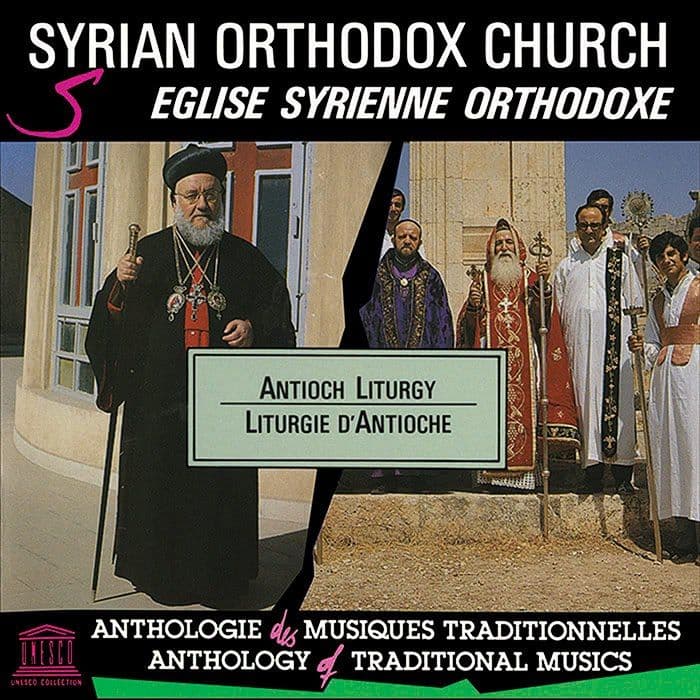
Syrian Orthodox Church: Antioch Liturgy
Anthologie Des Musiques Traditionnelles · 1983
 Wassily Minkow
Syriac Orthodox Church separated from the main Christian church in 451 AD. This happened after the Council of Chalcedon, where the decision was made to recognize two natures in Jesus Christ, divine and human. The Syriac Church did not accept the resolutions of this council and became one of the Ancient Eastern Orthodox churches, alongside the Armenian, Coptic, Ethiopian, Eritrean, and Malankara.
Although the Syriac Church is called "Orthodox," the division into Catholic and Orthodox churches occurred much later, in 1054, as a result of the Great Schism. Therefore, the theological traditions of the Syriac Church differ from those of the Byzantine and, consequently, Russian Orthodox churches.
The album Syrian Orthodox Church is dedicated to the spiritual chanting of the Syriac Orthodox Church. Its liturgy uses the Syriac language, similar to Aramaic, which was once spoken by Jesus Christ and his Apostles. Moreover, in Syriac spiritual chanting, the drones typical of Greek and Armenian liturgies are absent, but percussion can sometimes be heard as accompaniment.
Despite the fact that the followers of the church spread their faith throughout the Middle East and to the western coast of India, historically a significant number of believers lived in the vicinity of the Tigris River, where two main traditions of spiritual chanting developed. Western Syrians largely adhered to syllabic singing, where one sound of melody corresponds to one syllable of text. This helps articulate words clearly and makes the text more understandable to listeners, which was of paramount importance to western communities. Eastern Syrians, on the other hand, were more influenced by Indo-Iranian culture and used melismas—various melodic embellishments of sound.
By our time, the differences have blurred, so both singing styles can be heard in the west and the east. On the album Syrian Orthodox Church, tracks 1, 4, 5, and 8 represent the western tradition, while 2, 3, 6, and 7 represent the eastern tradition. Additionally, smaller singing traditions specific to different cities were formed on each shore. For example, the third track is the Turkish tradition of Urfa, and the second is the Tagrit tradition originating from Iraq.
Translation powered by chatGPT