

Parviz Meshkatian & Mohammad Reza Shajarian
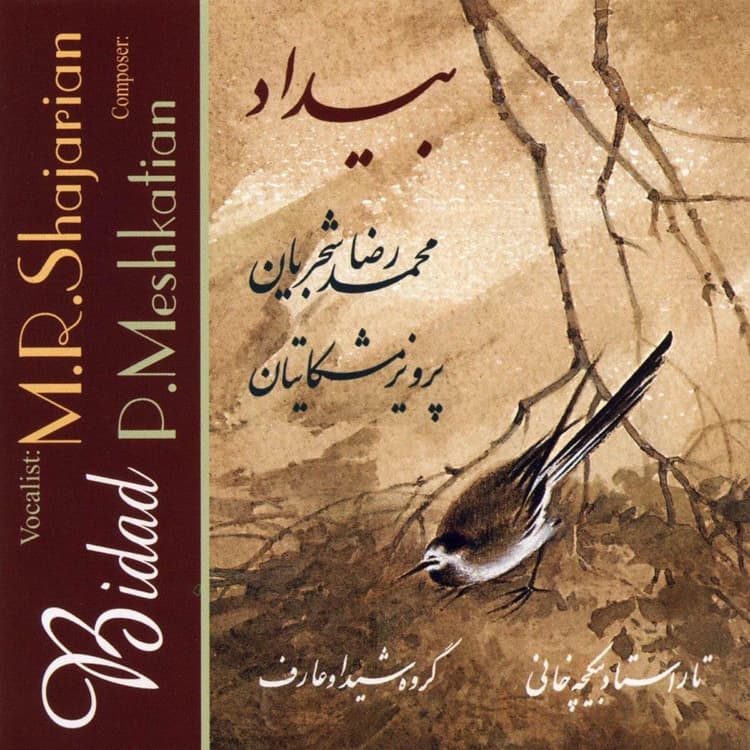
Bidad
Delawaz Records · 1985
 Wassily Minkow
After the Iranian revolution of 1979, the young generation of traditional musicians dedicated their work primarily to glorifying change. This gave new life to traditional music, which at that time had a reputation for being outdated, but also gave it an ideological hue. Bidad was one of the first works of that period that showed a new way for Iranian music to become relevant outside of the political context.
Bidad (بیداد), meaning "unrestrained," is a collaboration between the santur player Parviz Meshkatian and the singer Mohammad Reza Shajarian. The music on the album is based on the poetry of medieval Shirazi poets Saadi and Hafez. The album also features the outstanding tar player Mohammad Reza Lotfi.
The album is divided into two parts, each using different "dastgahs." Dastgah (دستگاه) is a set of rules for constructing a composition in Iranian classical music, similar to Indian raga or Arabic maqam. Dastgah can also be understood as a mode or a set of notes used in the initial part of a multi-movement work.
Several gushe (گوشه) - small musical ideas - are associated with each dastgah. Performing a piece in a specific dastgah means moving from gushe to gushe, demonstrating the multifaceted nature of the dastgah to the listener. The gushe "bidad," around which the album's sound is built, is what gave it its name.
In the first part of the album, starting with the composition Moghadameh (مقدمه), the dastgah humayun (همایون) is used, which corresponds in Western music to the major scale with a lowered quarter tone on the 2nd degree and lowered half tones on the 6th and 7th degrees (C Dk E F G A♭ B♭).
In the second part of the album, starting with the composition Pishdaramade Homayoun (پیشدرآمد همایون), in addition to humayun, the dastgah shur (شور) is used, which corresponds to the major scale with a lowered quarter tone on the 2nd degree and lowered half tones on the 3rd, 6th, and 7th degrees (C Dk E♭ F G A♭ B♭).
Translation powered by chatGPT