

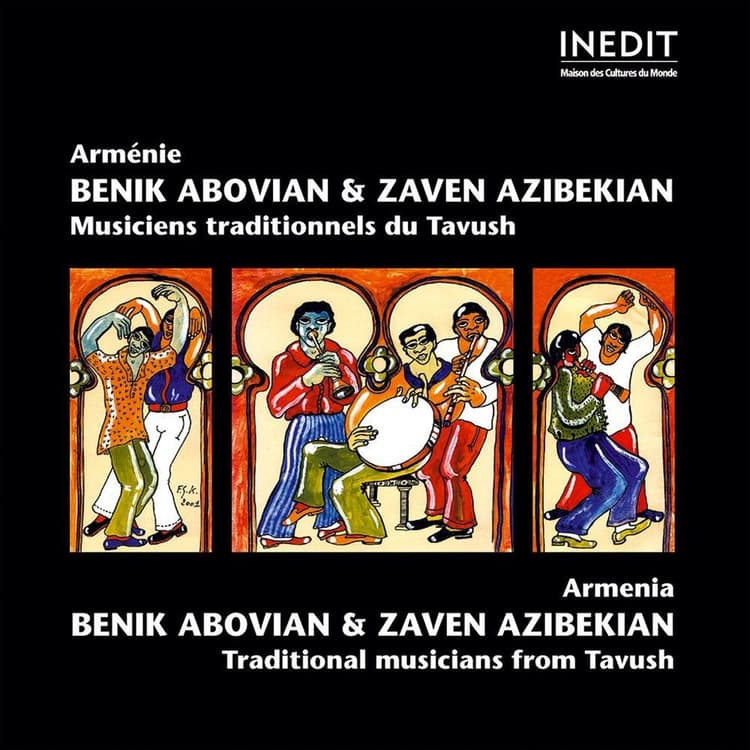
Benik Abovian & Zaven Azibekian
Traditional Musicians From Tavush
Maison Des Cultures Du Monde · 2002
 Wassily Minkow
Based on Armenia's geographical location and the multicultural history of the Caucasus, Armenian folk music can be considered part of the Middle Eastern musical heritage. However, over the centuries, Armenian music found its inspiration in rural and pastoral melodies, medieval Christian religious monodies, as well as in the urban traditions of gusans - bards of Sasanian, Parthian, and, of course, Armenian origin. This path gave rise to a deep and diverse musical culture that retains its unique character.
Modern Armenian folk musicians take pride in this diverse heritage, significantly enriched in the 19th and 20th centuries. The tumultuous period of that time, including the genocide of 1915, as well as the urbanization policy in Soviet Armenia, contributed to the preservation and perpetuation of folk music, both rural and urban, by village musicians.
The Tavush region, located in northeastern Armenia, near the borders with Georgia and Azerbaijan, is no exception. Like in many other regions of Armenia, folk music is still performed here in villages during weddings, festivals, and funerals.
Adherents of ancient traditions, gusans Benik Abovyan and Zaven Azibekyan, are recognized as some of the best performers of Tavush folk music. In 2001, in the village of Kirants and the town of Noyemberyan, Nicolas Berger recorded the musicians' play for the French Institute of World Cultures. Throughout the album, improvisations of musicians on various wind instruments such as zurna, duduk, and sring, accompanied by doula rhythms, can be heard.
Translation powered by chatGPT